What Chensi is
A place you write to yourself first, and decide later whether anyone else sees it.
Chensi is a place for keeping thoughts. Its order runs opposite to most social products: write to yourself first, decide later whether anyone else sees it.
The name comes from Marcus Aurelius’ Meditations. The Greek original of that title means “to himself” — he did not mean to publish, and what he recorded was not statecraft but whether he had told the truth that day. The act stands without an audience; Chensi means to carry it on.
What it looks like
The whole road looks like this:
- You jot down a line, called a fleeting note. It lands in an inbox only you can see.
- Some quiet day, you shape it into a thread — a real place with a title, a topic, something that can be responded to and linked. A new thread is visible to you alone by default.
- Notes and threads alike drift on your idea starmap. To go public, drag that star into the “Open plaza” basin.
- A public thread reaches the plaza, where others may write responses — one per person to start with, written all the way through.
- Thought it through? Write the closing note yourself and close the thread. Done looking at it? Tuck it into the inner world and take it back anytime.
These five steps are not a required route. Only jotting notes and never going public is a complete use — in fact it is the path the defaults were designed around.
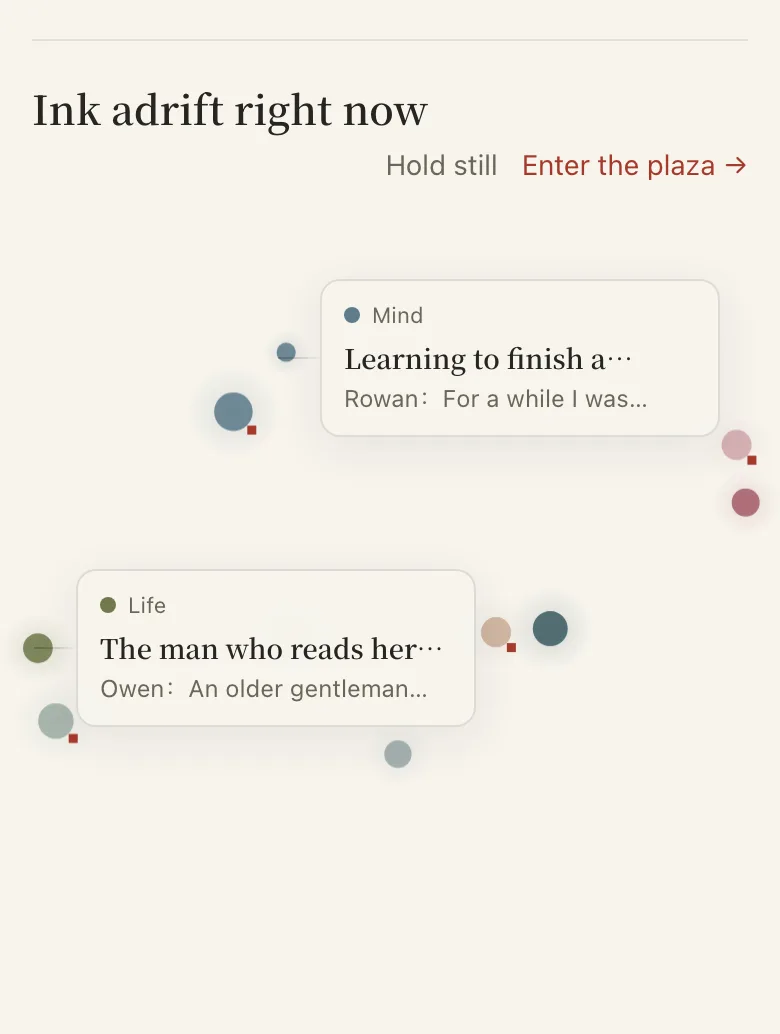
You can glimpse a little without registering: the top of the “All features” page drifts with public ink — a random sample of up to 24 pieces; tap one and read it. With fewer than 8 public posts the whole block does not appear — a sparse sky is worse than none.
What it does not try to do
There are no follower counts on Chensi, no downvotes, no negative reaction tiers. A response area exists, but its rules were rewritten: each person gets one response to start; only once the author has written back to you, or stamped your response, may you keep writing in your own strand. See The order of responses.
Plaza ordering has four lanes, all laid out for you to pick: “Quality” runs the ranking engine at full, “Latest” is a plain timeline, “Friends” swaps the pool, “From afar” drifts only closed threads. All four ignore your footprint. See Ranking, laid out for you to choose.
Does it cost money
No. Every feature on Chensi runs inside free quotas, the AI ones included — which is why they carry daily generation caps, see Limits and numbers at a glance. No ads, no third-party tracking scripts, no data for sale.
Whatever remains is probably on the FAQ page.
Related pages
- Five-minute start Sign up, then run the whole path once.
- Writing to yourself You are the first reader. Every default follows from that.
- Interface map Where every entry point lives: desktop top bar, phone tab bar, and the long tail.