Keeping and writing back
After reading someone else, come back to yourself — write a note now, or keep it to think on.
When you finish reading someone else’s thread, a row sits between the body and the response area: “You’ve read it. Now back to you.” Two actions stand beside it — Write a note and Keep to think on.
What Chensi inherits from Meditations is this: one person speaks honestly to themselves, another reads it, and so begins speaking to themselves. Before this row existed, finishing a thread offered two exits only — respond to the author, or close the page. The step of coming back to yourself had nothing behind it in the product.
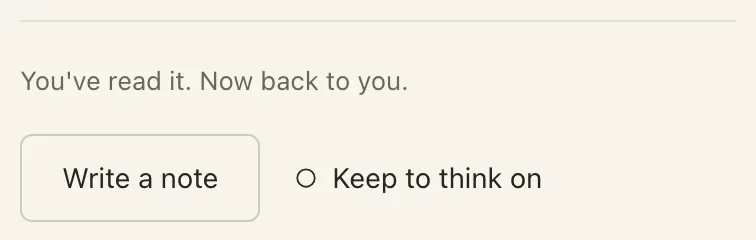
When a passage brings up something of your own. That thought is yours, not a response to the author — it belongs in your own inbox, not posted under someone else’s thread.
Write a note
Tap “Write a note” and an input box unfolds in place, a chip at its top naming the thread this note came out of. Keep it, the form folds away, and you are still on this thread — read, noted, reading on.
What comes out is a fleeting note, landing in your inbox to live among the ones you jotted offhand. It carries its source, and the card reads “drawn out by ● Someone, ‘Title’”; one tap returns to the original thread.
Inside the inbox this note is like any other: it can be shaped into a thread, and it can be deleted.
Keep to think on
When nothing will come right now, tap “Keep to think on”. The thread becomes a kept card in your inbox — a cinnabar rule down its left side, carrying the thread’s name, its author, and a summary.
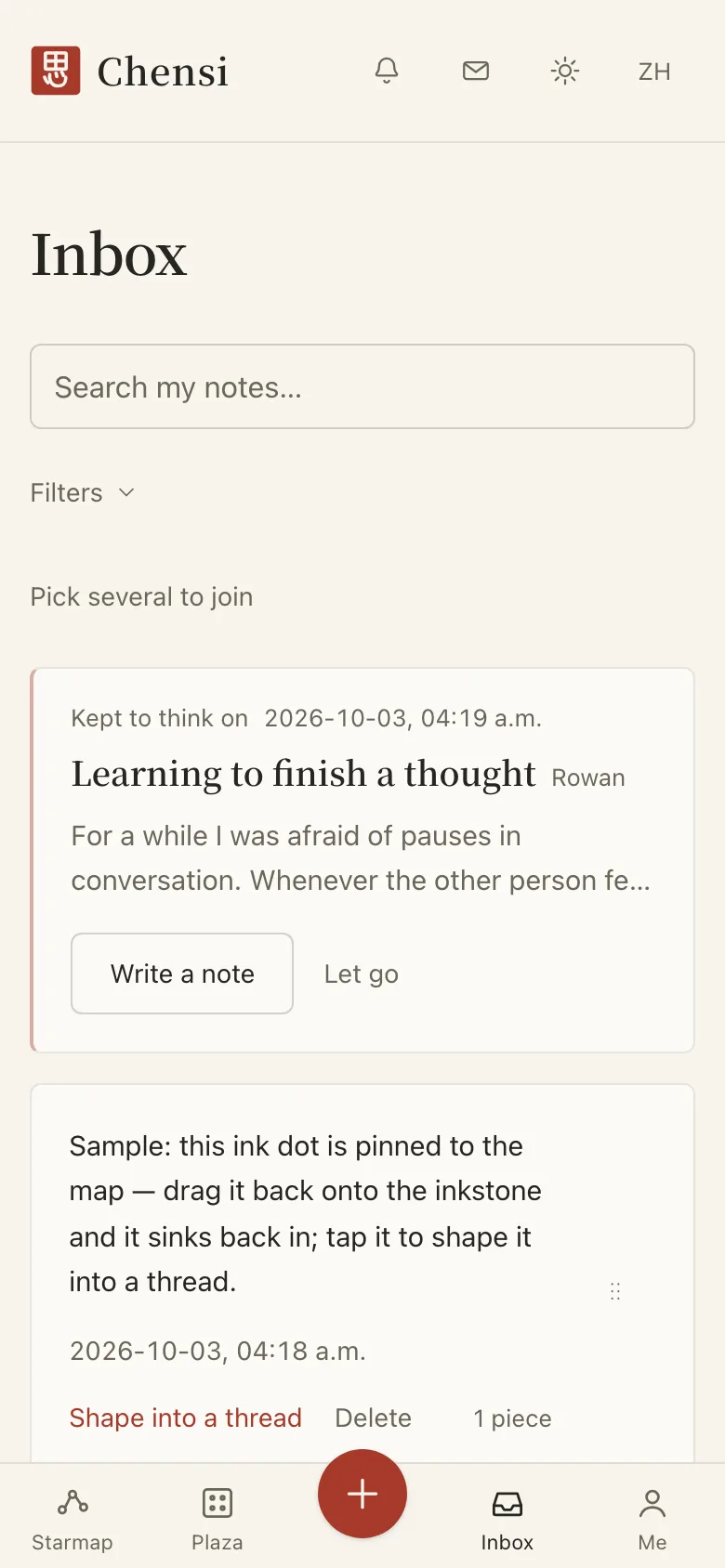
Come back, write a note against that card, and the card is replaced in place by the note you just wrote. That is what finishing the card means.
Done thinking about it? Tap “Let go”; the card fades out with no confirmation dialog — the act is reversible (you can keep it again at any time), so it should not have a gate in front of it.
- One card per thread
- A thread can have only one kept card at a time. After writing a note you may keep it again.
- Your own threads have no such row
- What self-examination works on is someone else’s words.
- Logged out, no row
- No button you cannot use.
- If the original goes
- When the author deletes the thread the kept card goes with it (it points at nothing now); when the author turns it private the card stays, reading “the original is no longer readable”, with only “Let go” left. A note you already wrote stays forever — those are your own words.
- Rate
- Writing a note shares one ceiling with quick capture: at most 10 a minute.
How it differs from quoting one line
The “Write a note” on this row is written against the whole piece, with no quote. To write against one line, select that line in the body — see Quote and write.
Both routes store the same kind of thing (a fleeting note with a source); they differ only in whether the line comes along with it.
How private these two acts are
- The author is not notified — unless you shape it into something public. Keeping to think on, and the note written into your inbox, stay entirely unknown to them; only when you shape a note carrying a quote into a public thread does the source author get one notification (see Quote and write). A note without a quote notifies nobody even when public.
- There is no “kept N times” number. No public surface shows a count of either act.
- The source is visible to you alone. “Which thread drew this note out of me” does not go public when the note is shaped — what goes out is the passage you wrote, not who you have been reading. (A quote is different: those are words you copied in, and they go public with the thread, attribution and all.)
- A kept card, like a note, is readable by you alone at the database level.
Deliberately not built
- Plaza cards carry no “Keep to think on” — the act belongs after reading, not on a headline.
- There is no bulk “let go”.
- A kept card never nudges you and never raises a red dot. To have a thread come back to you later, that is what a reminder is for.
Related pages
- Quote and write Select the line that moved you and write your own note beside it — the quote comes along.
- Inbox Notes you have not shaped yet, plus the threads you kept to think on. Only you can see it.
- Quick capture One line is worth keeping. It lands in an inbox only you can see.
- Privacy What is collected, what stays private, where it lives, when anything leaves, and how far moderation reaches.